Take payment with Swish, the phone payment nearly every Swede has: the customer approves in the Swish app with BankID, and the money is in the shop's bank account in seconds. Payment requests, the status that follows them, the QR code a computer shows and the link a phone opens, and refunds, written entirely in Osy# over the public Http.* surface.
Use case
Any app that sells to people in Sweden: a shop's checkout, a café's pre-order page, a booking that takes a deposit, a club collecting a fee. Swish is what a Swedish customer reaches for first, and it costs the merchant a small fixed fee rather than a card percentage.
It plugs into Osysharp.Payments, so an app that already offers a card or Klarna lists Swish beside them and nothing that sells changes.
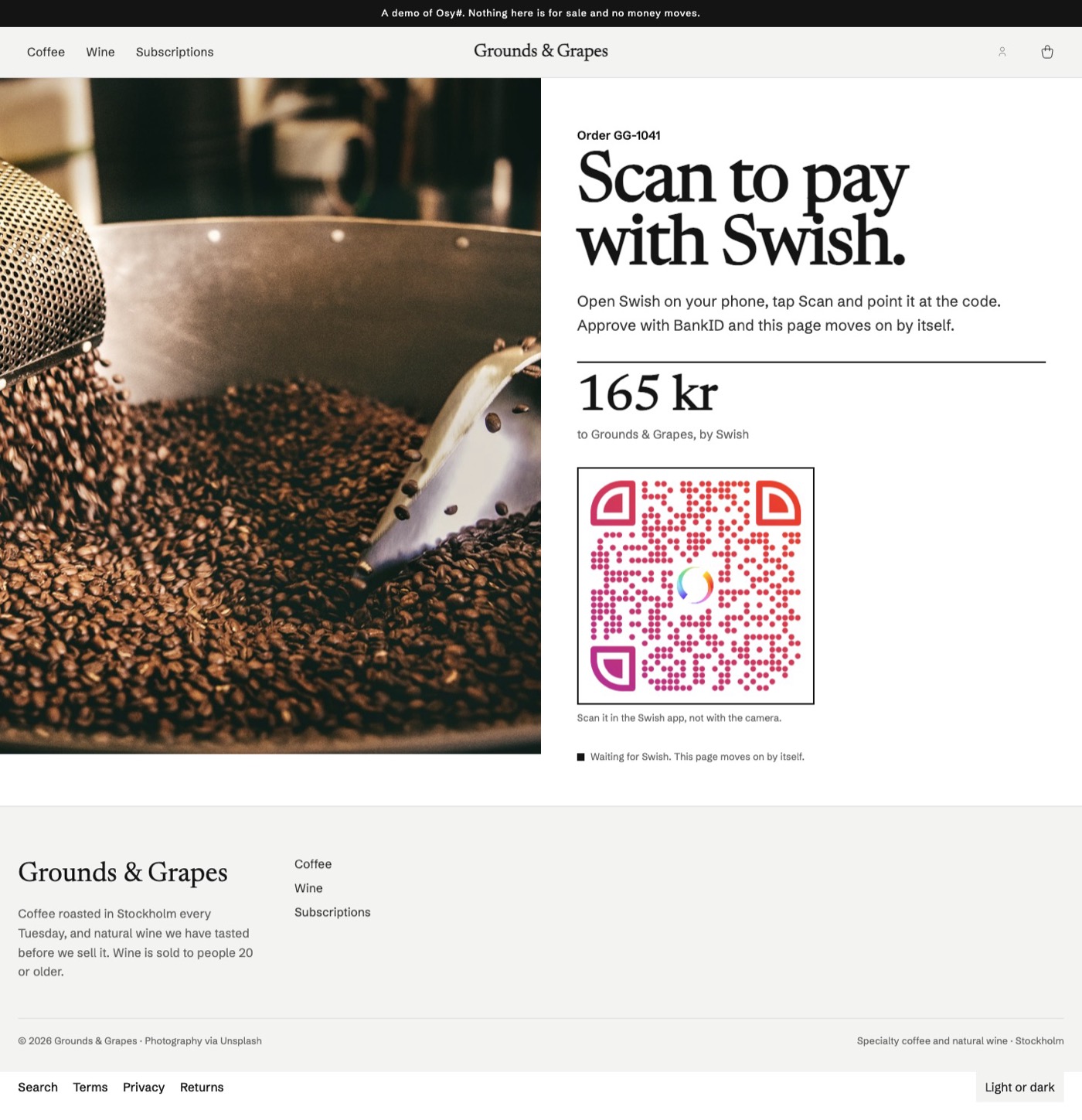
| On a phone the page opens Swish itself | Offered at the checkout once the certificate is set |
|---|---|
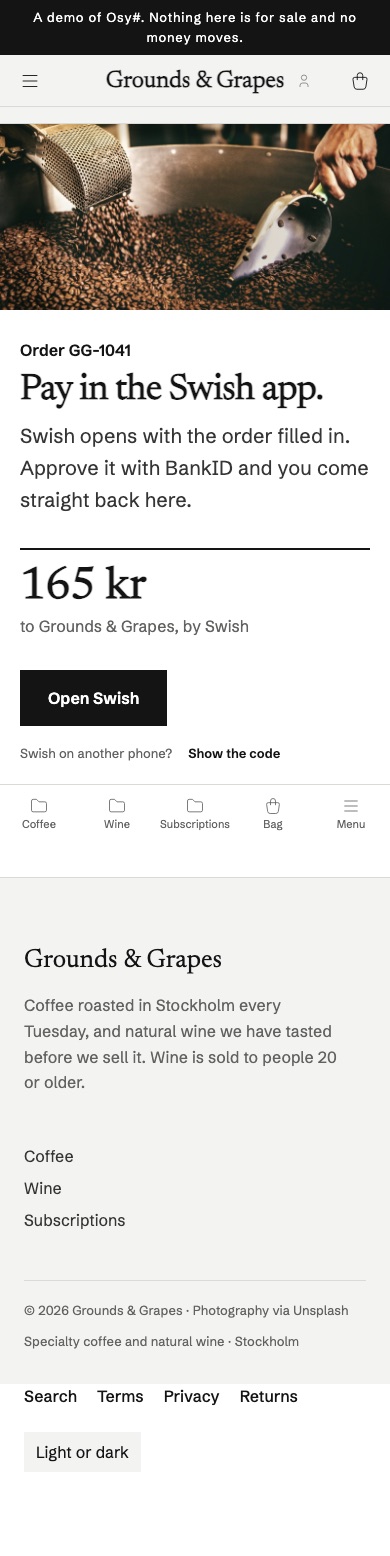 | 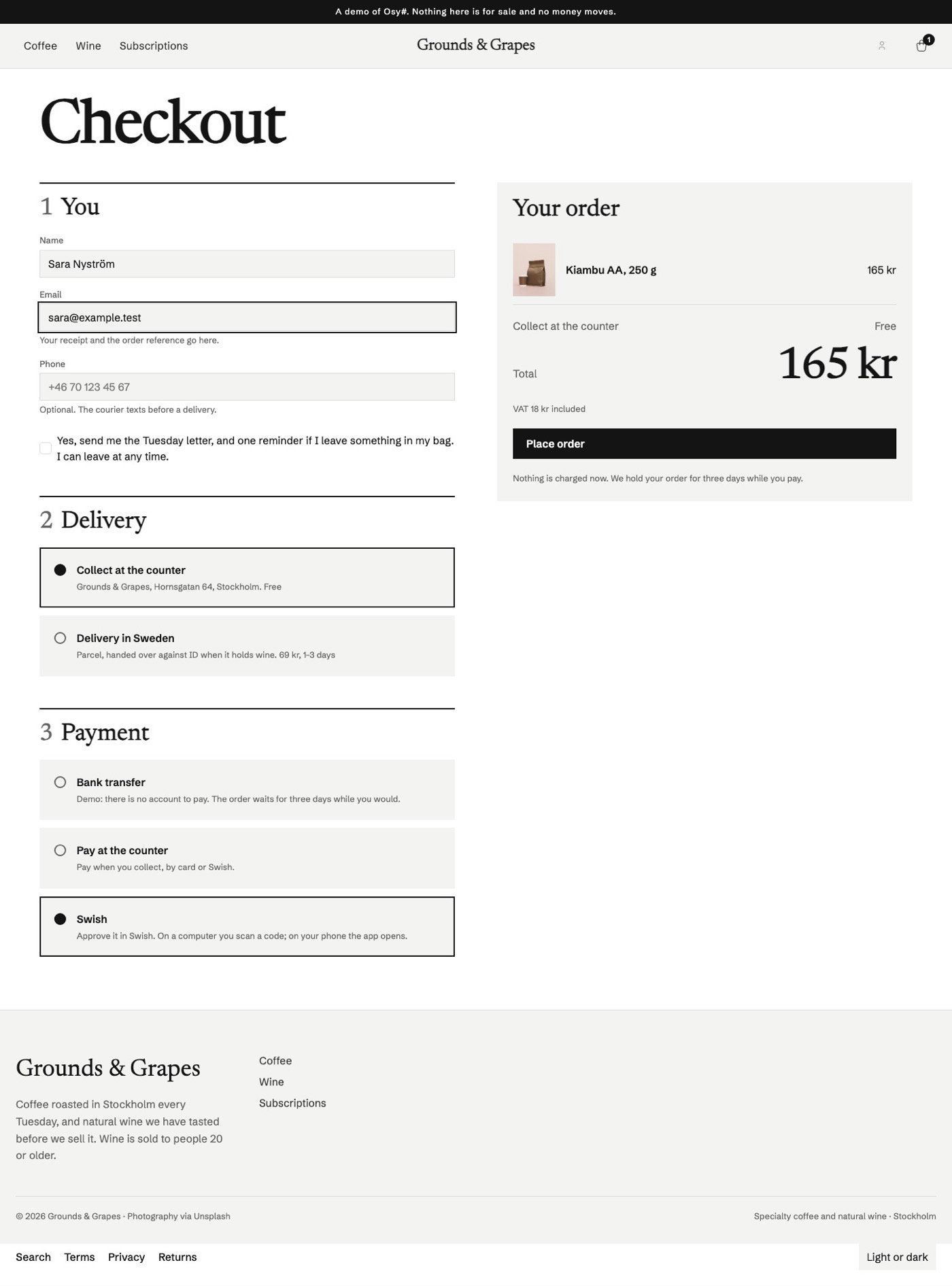 |
From Grounds & Grapes, a coffee and wine shop built on the shop kit.
A certificate, not a key
Swish has no API key. A merchant is whoever holds the TLS client certificate its bank issued for its Swish number, and every call is made over mutual TLS. This package never sees that certificate: the app grants it the identity with clientCert, and the platform presents it on the package's calls.
osy
// app.osy
app Shop {
  model "**/*.osy";
  use Osysharp.Payments@0;
  use Osysharp.Payments.Swish@0 {
    egress     "cpc.getswish.net";        // Swish
    egress     "mss.cpc.getswish.net";    // the Merchant Swish Simulator, while you build
    egress     "mpc.getswish.net";        // Swish's QR generator (public, no certificate)
    clientCert "SwishCert";               // the merchant certificate, which the package never reads
  }
}

app.Secrets = [ new Secret("SwishCert"), new Secret("SwishCertPassword") ];
console
osy secret set SwishCert --file swish.p12 --base64
osy secret set SwishCertPassword
While you build, use the simulator's test certificate and its test number 1234679304, both published by Swish on developer.swish.nu. Your bank issues the real certificate once you have a Swish for merchants agreement. The Swish hosts use a public certificate authority, so no serverCa is needed.
Offer it
osy
using Osysharp.Payments.Swish;

SwishPayments Swish() {
  return new SwishPayments { SwishNumber = "1231181189",
                             CertificateSet = Security.IsSecretSet("SwishCert") };
}

app.Shop = new ShopSetup { Payments = [ Swish(), /* a card, a transfer… */ ] };
Without its certificate Swish is not offered. Swish moves Swedish kronor only: for a checkout in any other currency it is not offered, and says why (CurrencyRefusal), which the shop's desk shows beside it.
How a payment goes
- Start. The kit creates a payment request under an id it derives from the payment's idempotency key (
PUT /api/v2/paymentrequests/{id}), so a retried start is the same request to Swish, never a second one.- With the customer's mobile number (
PaymentRequest.CustomerPhone), Swish sends the request to their phone. - Without it, Swish answers a token. On the phone that holds Swish your page opens
AppLink(token, returnUrl); on a computer it showsQrCode(token), drawn by Swish, which the customer scans in the Swish app.
- With the customer's mobile number (
- Wait.
Startsends the customer to your waiting page (PayPage,/swish/{reference}/{id}/{token}by default). The page asksCheckevery couple of seconds. - Settle. Swish posts a callback to your payments endpoint when the request is paid, declined, cancelled or has failed. The callback is not signed, so the kit reads only the id out of it and asks Swish itself, over your certificate, how that request stands. A request is Paid only when Swish says so, for your Swish number, this reference and this amount in SEK.
- Refund.
Refundgives back all or part of a paid payment from the bank's own payment reference, with the shop's number as the payer, under an id derived from the refund's key. Its status is asked the same way; a refund is done atPAID, not atDEBITED, because the receiving bank can still refuse it.
A request the customer lets time out (three minutes) or declines can be asked again with Again(id, returnUrl), which asks for exactly what Swish recorded for the old one, so nothing a page passes can change what is paid.
At a shop's counter
SwishPayments is also an ICounterPayment (the Osysharp.Payments counter contract): list it in the shop's CounterPayments and the till shows Swish's QR code on its own screen for the customer standing there to scan (StartAtCounter — a request with no payer number), asks Swish until it is paid (CheckAtCounter, the same check as Check: this number, this reference, this amount), and withdraws it if the sale is called off (CancelAtCounter). A counter payment is refunded like any other Swish payment.
What is in it
SwishPayments | the Osysharp.Payments provider: start, check, callback, refund, cancel, and the page helpers QrCode, AppLink, Again |
SwishClient | the Commerce API: payment requests v2 (create, read, cancel), refunds v2 (create, read), the QR generator |
SwishWire | the request and response shapes, each field under its Swish name |
SwishAmount · SwishMessage · SwishReference · SwishPhone · SwishInstructionId | Swish's own rules applied before Swish has to refuse: kronor with two decimals, a 50-character message in Swish's alphabet, the reference format, a payer's number with its country code, an id Swish accepts |
Source and tests
Everything is in model/, three files of Osy# and no C#.
tests/ is the producer's own project, every call to Swish stubbed. They cover both ways to start, a retried start and a retried refund each staying one request, polling to every outcome, a forged callback that says PAID settling nothing, a paid request for another order, amount or Swish number not counting, refunds and their callbacks, and the kronor-only refusal. osy publish runs them and refuses a version that fails.
To build your own on top of it — another Nordic phone payment, or Swish payouts — fork the folder: the provider is one class implementing IPaymentProvider, and SwishClient is ordinary Osy# over Http.*.
Get it
Add the kit to your app’s manifest:
osy
app MyApp {
  use Osysharp.Payments.Swish@0 {
    egress "cpc.getswish.net";
    egress "mss.cpc.getswish.net";
    egress "mpc.getswish.net";
  }
}
Then run osy lock: it downloads the release, verifies it by its content address and pins that version in osyrin.lock. osy kits Osysharp.Payments.Swish shows what the kit is for, from inside your app.