A shop's books, from what the shop already records: every invoice is a sale and every credit note a sale given back. An add-on to Osysharp.Shop: use it, and the books page stands in the store's desk and the accountant gets a file.
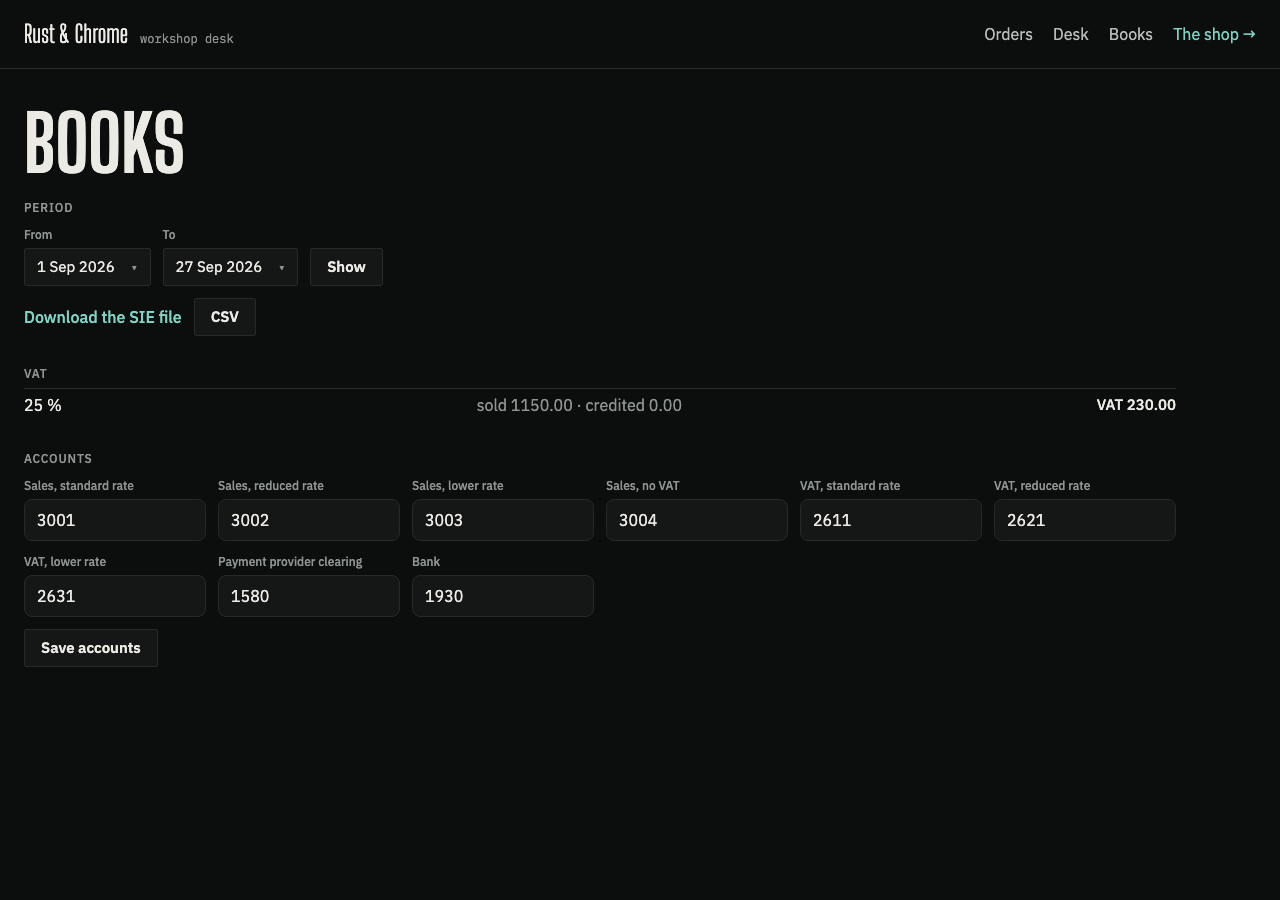
- SIE 4 — the Swedish bookkeeping interchange (Fortnox, Visma, Björn Lundén): one verification per day, sales and output VAT per rate, against a clearing account for provider payments (card, Klarna) and the bank for what was paid by hand. Encoded PC8, as the format requires.
- CSV — one row per document and VAT rate, for Xero, QuickBooks or a spreadsheet.
- The VAT report — per rate, for any period: sold, credited, and the VAT owed.
- Payouts, reconciled — each payout from Stripe or Klarna matched to the orders it pays for (and any payment the shop has no order for, flagged), and booked: the bank receives the net, the provider's fees are a cost (6570), the provider clearing account is emptied. So the bank line "Stripe 12 431,20" explains itself.
- Money the shop owes — a gift card sold is a debt, not a sale (a multi-purpose voucher: no VAT until it is spent), credited to 2421; spending one debits 2421 and the goods it buys are sales with all their VAT; store credit spent or given back moves 2420 the same way; a card or credit staff give away is a cost (5990); what is left on a card when it expires or is voided is income without VAT (3990). The CSV carries a gift card sold as its own
voucherrow. A card whose own sale is refunded is voided WITHOUT a write-off: the credit note already took the debt back, so the refund is booked once. A card REISSUED in the shop's own currency (its own no longer sold, the shop kit'sReissueGiftCard) is its own verification: 2421 debited for what the old card owed (at the rate it was sold at) and credited for the new card — the debt moved, no sale, no VAT, no write-off; what converting each side to the öre leaves (a single-purpose card's VAT, rounded twice) goes to 3960/7960. - Single-purpose gift cards — for a shop that sells them (
ShopSettings.GiftCardsAreSinglePurpose, see the shop kit's README; VAT Directive 2006/112/EC art. 30a(2) and 30b(1), Skatteverket's enfunktionsvoucher) the VAT is due on the SALE: 1930 debit 500, 2421 credit 400, 2611 credit 100. Spending it: 2421 debit 400, and the goods it paid for credited toSalesSinglePurpose(3009, Försäljning mot enfunktionsvoucher, moms redovisad vid försäljningen) with no VAT — kept apart from 3001–3003 so it is never read as a second taxable sale. The VAT report counts the card when it is sold and never when it is spent (file the VAT return from it, not from the sales accounts); the CSV marks what such a card paid as avoucher-paidrow. A refund of the card gives its VAT back; a refund of what it paid gives back VAT only on the part paid in money. A card that expires writes off what it owed (400), and its VAT stays declared. - Sales in another currency — a shop that SELLS in a currency besides its own (Osysharp.Shop's "Sell in EUR") keeps its books in its own: each such sale is its own verification, converted at its INVOICE's rate — the rate of the day it was paid, which the invoice records and states its VAT at (VAT Directive 2006/112/EC art. 230, with art. 91(2) allowing the ECB's rate) — and its text names the currency, the amount and the rate: "sale GG-1041, EUR 110.00 at 11.3205 SEK/EUR (European Central Bank, 2026-09-28)". A credit note is converted at its invoice's rate, so the VAT given back is the VAT declared; a gift card in euros is owed at the rate it was sold at. The VAT report and the CSV are in the shop's currency; the CSV adds
currency,gross_in_currencyandrate. - Currency gains and losses — what a payout actually brought in for a sale in another currency, against what the sale was booked at, is a gain (3960 Valutakursvinster på fordringar och skulder av rörelsekaraktär) or a loss (7960 Valutakursförluster på fordringar och skulder av rörelsekaraktär), booked with the payout. The rate it settled at is the provider's own where the provider converted it — Stripe's balance transaction carries
exchange_rate(https://docs.stripe.com/api/balance_transactions/object), read intoPayoutLine.SettledRate— and, for a payout that is itself in the sale's currency (Klarna settles each currency in itself), the ECB's rate of the payout's day, kept by the shop's rate job (ExchangeRateDay). The clearing account is emptied by exactly what was booked into it. - Accounts — the BAS numbers by default (3001/3002/3003/3004 sales, 2611/2621/2631 VAT, 1580 provider clearing, 1930 bank, 6570 provider fees, 2421 gift cards, 2420 store credit, 5990 given away, 3990 expired cards, 3009 what a single-purpose gift card paid for, 3960/7960 currency gains and losses — the BAS chart, bas.se), editable on the desk.
Use it
osy
// app.osy
use Osysharp.Shop@1 { egress "api.resend.com"; secret "ResendApiKey"; }
use Osysharp.Shop.Bookkeeping@0;
That is all: the books are the kit's own page, /staff/books (BooksPage), standing in the store's staff frame (WorkspaceShell) and listed in its navigation ([Nav]). The panel itself is DeskBookkeeping(), for a page of your own; the chart of accounts is a section of the store's settings.
From code: Verifications(from, to), VatReport(from, to), SieText(from, to) / SieLink(from, to), CsvText(from, to) / CsvLink(from, to) — periods are DateOnly, both ends included.
The books read the shop's invoices and credit notes, never its orders: an order changes, a document does not, so an export of a period comes out the same whenever it is made.
Get it
Add the kit to your app’s manifest:
osy
app MyApp {
  use Osysharp.Shop.Bookkeeping@0;
}
Then run osy lock: it downloads the release, verifies it by its content address and pins that version in osyrin.lock. osy kits Osysharp.Shop.Bookkeeping shows what the kit is for, from inside your app.