You are here: Agents in an Osy# app › Stories › Somebody is hired
Summary#
Tallis & Wren is an engineering consultancy. A director needs a senior implementation consultant, and the firm owns that until somebody has accepted an offer — through however many applications, interviews and second thoughts.
This is one hire, from Monday 3 March to Monday 24 March.
Description#
Who is involved?#
| Person | Their job | What they see and may do |
|---|---|---|
| Vera Lindqvist | director; the hiring manager | asks for the hire; decides the offer; follows the hire. Not what the AI models cost |
| Noor Haddad | talent partner | owns the hire; answers for the agents; reads all of it, with what it cost; steps in when an agent cannot go on |
| Emil Brandt | consultant; interviews | is asked for his feedback. Sees the hire and who is in the running — not what anybody thought of a candidate |
| Signe Nyberg | consultant; interviews | the same; away in the week it matters |
| Ruth Okoye | answers privacy requests | her requests. Nothing a hire holds |
| Ilse Varga, Petra Olin, Tomas Reyes, Jonah Wicks | the people who applied | have no account: each answers what is asked of them through a link of their own |
| Agent | Its part | What it may do alone |
|---|---|---|
| Hiring coordinator | in charge of the hire: makes the role clear, has the applications read, compares the candidates | write the requirements down; ask the manager a question; hand each application on. An offer is proposed to a person, every time |
| Application reader | reads one application against what the role needs | record how it stands — on a small allowance for each application |
What is the process?#
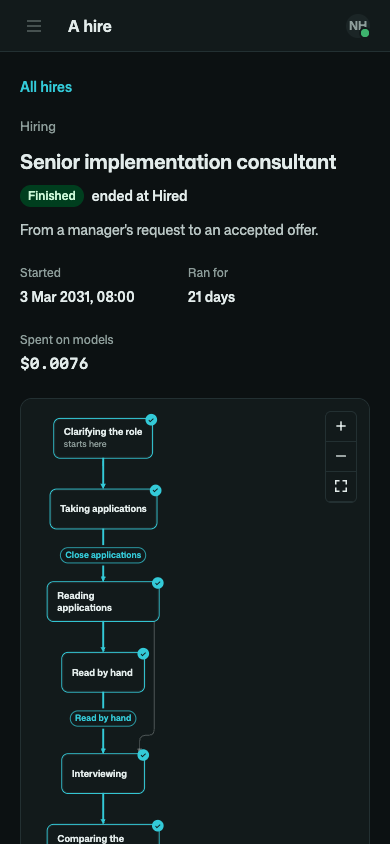
Seven steps a hire can be at, and three ways it can end. Three of the steps are the coordinator's work; three wait for people; one — "Read by hand" — exists for when the agents cannot.
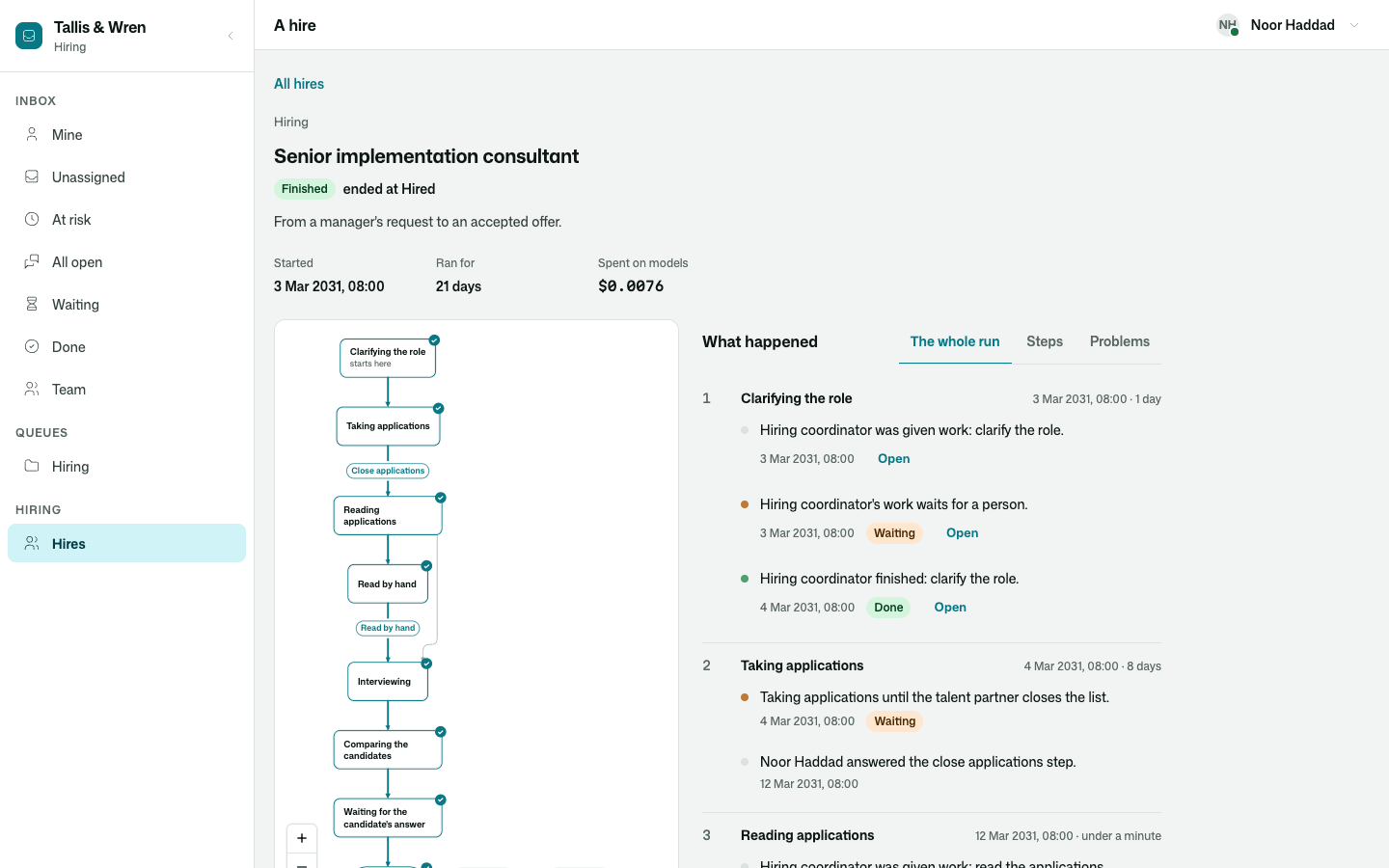
Behind the process is a job: an [[agent-guide-glossary#assignment|assignment]] with three things that must be true before it is done — the role is clear, two candidates have been interviewed, an offer is accepted.
Monday 3 March: a request, and a question back#
Vera writes: "Somebody who can lead a client rollout alone. Soon." The Hiring coordinator reads it and finds two things it cannot know. It may ask a person, and the work is being done for Vera, so the question goes to her inbox: must they have led a rollout for a public-sector client, and by when should they start?
On Tuesday she answers: yes, public sector; by 1 June. The coordinator writes the requirements down as an item of the job, and the first thing "done" means is met by that item.
Wednesday 12 March: four applications, read at once — and one that is not#
Four people have applied. Noor closes the list. The coordinator hands each application to the Application reader, all four at once, each on its own small allowance.
Three are read. Ilse Varga has led a rollout alone for two county councils: she meets what the role needs. So does Tomas Reyes. Jonah Wicks has done support and training, and does not. Petra Olin's application is eleven pages; the reader spends most of its allowance on the first step and is stopped before the next — its money ran out.
The process was written to expect this. An application no agent read is not an application nobody reads: it says so on the run, and hands that one to the talent partner. On Thursday Noor reads it by hand: nine rollouts, the last three alone on site.
Thursday to Monday: three people outside#
Ilse, Petra and Tomas are asked when they could meet, and when they could start. None of them has an account. Each is sent a link; each link opens that one question, on a page with two fields, and nothing else.
Ilse answers on Friday — she could start in April. Petra answers on Saturday — not before August.
Monday 17 March: one withdraws, and asks to be forgotten#
Tomas rings Noor: he has taken another job. What was still asked of him is called off, and the hire stops waiting for him.
He also asks the firm to erase what it holds about him. Ruth, who answers privacy requests, files and approves the request on Tuesday — without being able to read one thing the hire holds. After it has run:
his application and the reader's assessment of it are still items of the job, in their place, and say only that they were erased, when and why;
the firm's own record says that a candidate applied and withdrew, and no longer who;
the piece of the agents' work that read the four applications keeps what it cost and the check that nothing was changed, and none of its words — a piece of work is erased whole;
the other three candidates are word for word as they were, and the hire goes on.
the question that was sent to him is still there, called off — with nothing of who it was put to or what it said; and the hire's own page, which said "Asked Tomas Reyes, by a link", now says that somebody was asked something there who has since asked to be erased.
Tuesday to Thursday: two interviews, and a request that goes on#
Emil is asked for his feedback on Petra, Signe for hers on Ilse — each a form: would you put this person in front of a client in their first month, and what did you see. Each has two days.
Emil answers the same day. Signe is away. On Wednesday her request's date passes and it goes on to Emil, who sat in on that interview too; on Thursday he answers it. What an interviewer thought is kept on the job as a finding that few people read: the manager, the talent partner, and the coordinator's own account.
Thursday 20 March: an offer refused, and another approved#
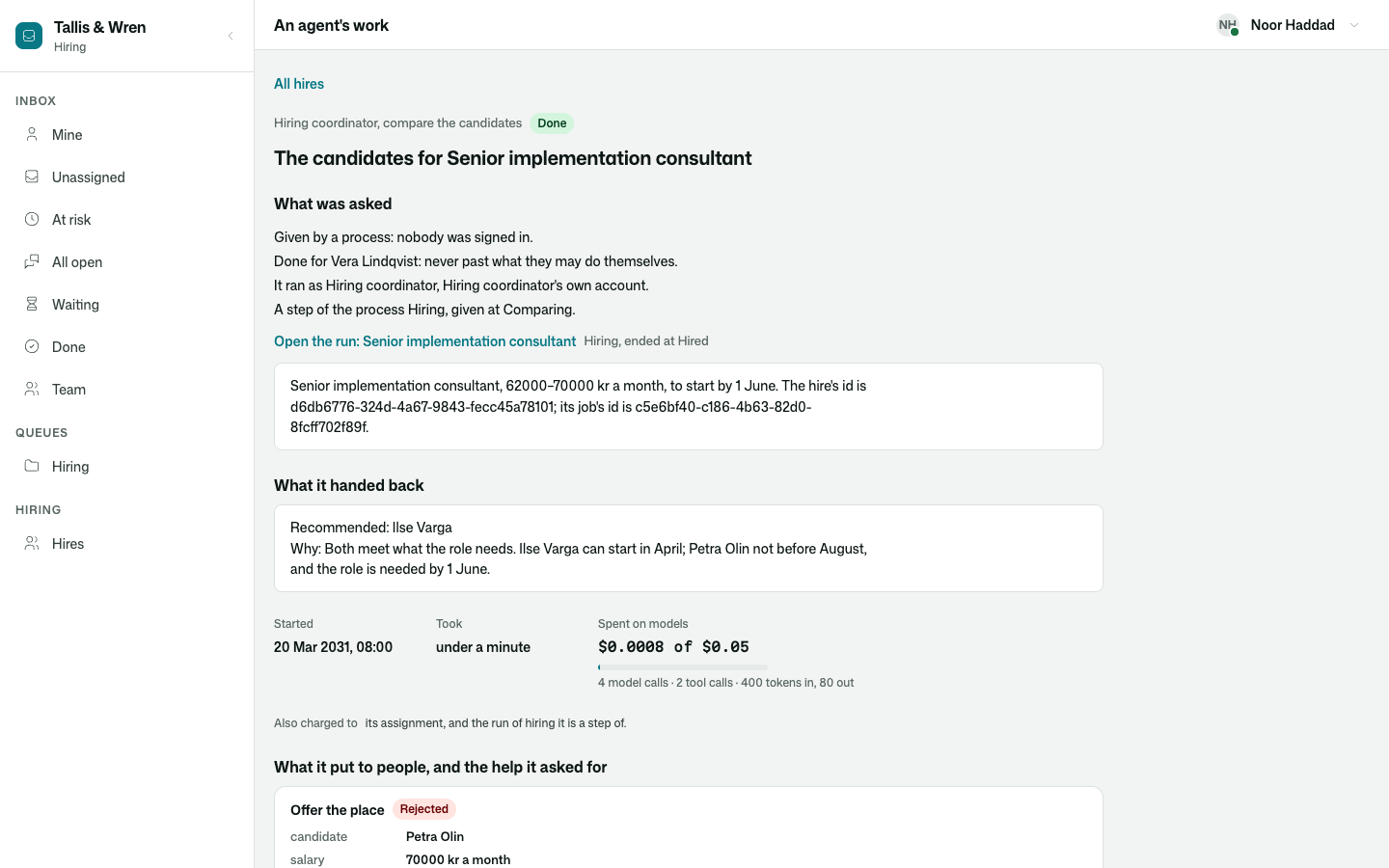
The coordinator compares the two candidates from what the job holds, and wants to offer Petra the place at the top of the range. It may not offer anything alone. The [[agent-guide-glossary#proposal|proposal]] is put to the person the work is done for — Vera — in her inbox.
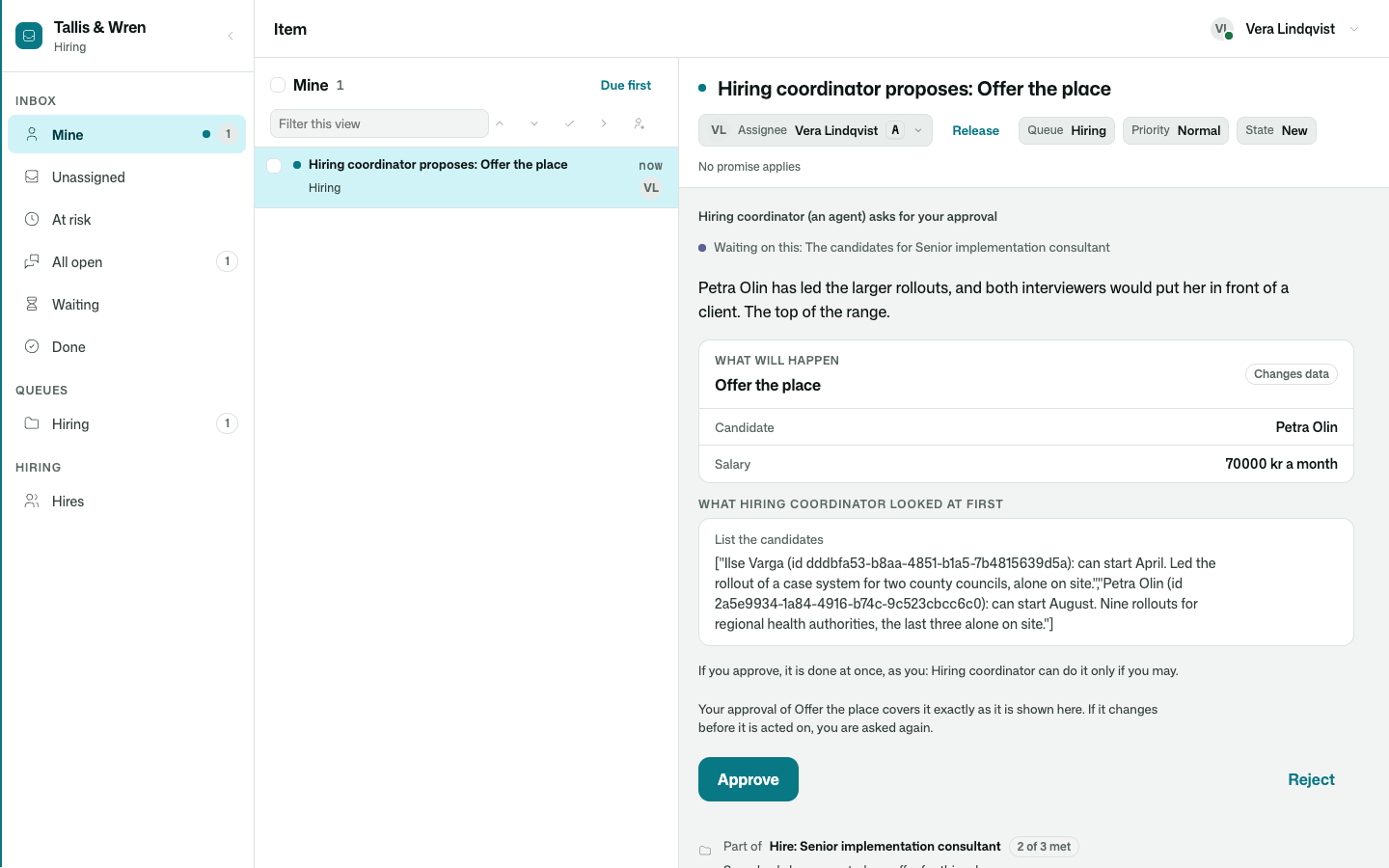
Vera says no, and why: "Petra cannot start before August. We need somebody by 1 June." Her reason reaches the coordinator as the answer to what it tried. It proposes Ilse, at 66000. She approves, and the offer is made at that moment, as her. The decision is kept as an item of the job: who, and why.
Monday 24 March: yes#
The offer is put to Ilse through a link, as a yes or a no to exactly this: this role, this salary, this start. She says yes. The last thing "done" means is met by her own answer, and the job is completed. The hire ends at "Hired", 21 days after it began.
What does the hire's page say afterwards?#
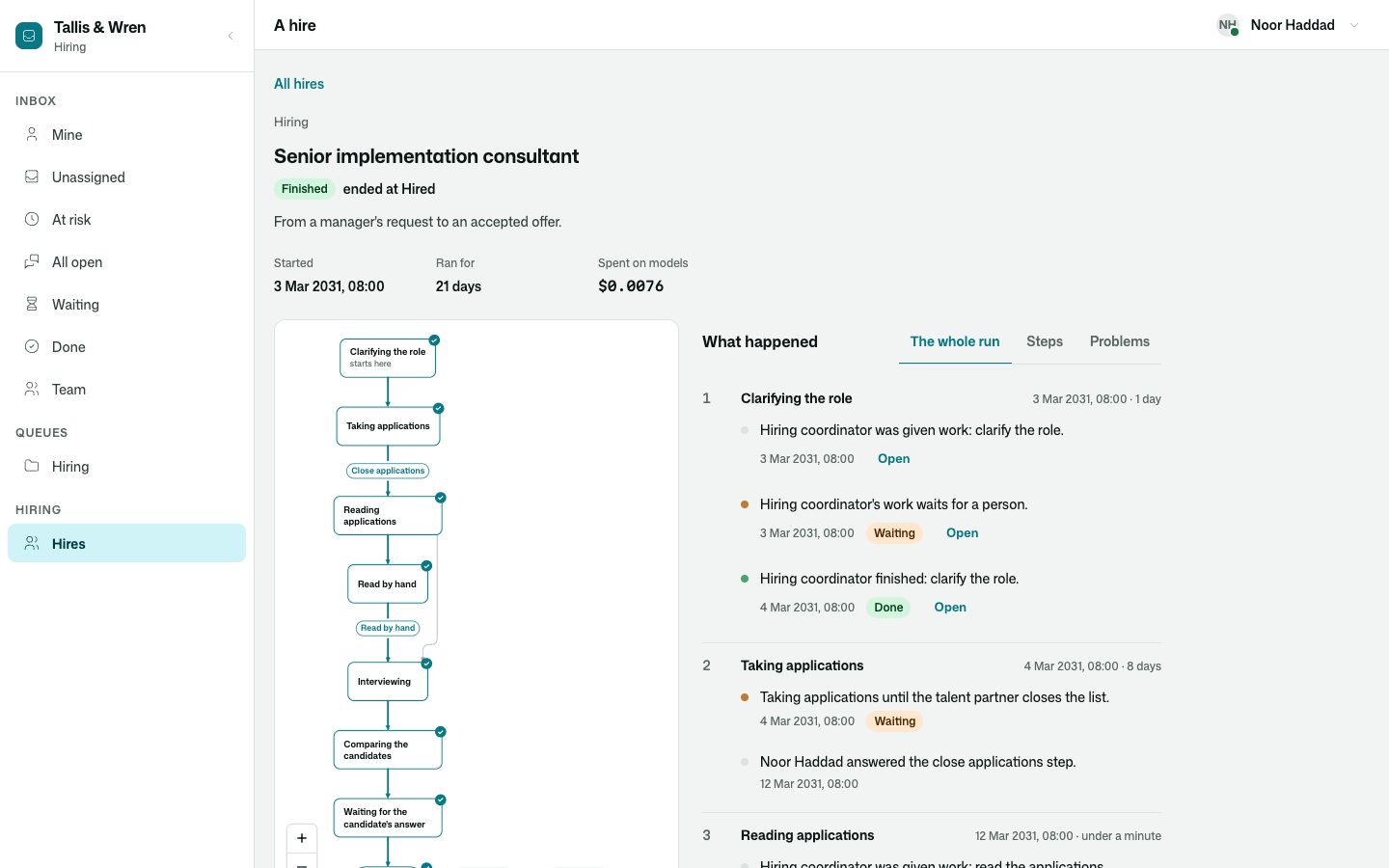
Each step it was at, with how long it stood there and what happened. The step that asked five people says each of them: three asked by a link, two who answered and after how long, one whose request was called off; one interviewer who answered, and one whose request was not answered in time and went on to a colleague. A line about a request opens the request in place.
What did each person see?#
- Noor, the talent partner, reads all of it: the job and everything it holds, the run and what it cost, each piece of the agents' work.
- Vera, the manager, reads her hire, its run and what was thought of each candidate. What the AI models cost is not shown to her.
- Emil, an interviewer, sees the hire and who is in the running. He cannot read what anybody thought of a candidate — his own feedback included, once it is given — nor the run, nor a line of the agents' work.
- Ruth sees her privacy request. She cannot read the hire, a candidate, or anything the job holds.
- A candidate's link opens the one thing they were asked, with their own answer once given. Nothing else.
What was refused, and what was stopped?#
- A refusal. The manager's no to the first offer, with its reason, which the coordinator acted on.
- A limit. The reader's allowance on the longest application: stopped before a call that did not fit.
- A step taken over. That application, read by a person because no agent had.
- A date that passed. An interviewer's request went on to a colleague; it was not closed.
- A request called off. What was asked of the candidate who withdrew.
- An erasure. What the job, the agents' work, the requests put to him and the firm's records held about him.
- A job that is not done. With the offer made, the job could not be completed: its last criterion was the candidate's to meet.
Where is this written down?#
In the test app of the kit that tells a process's requests on its run — a firm called Tallis & Wren.
a_hire_is_carried_from_the_managers_request_to_an_accepted_offer is the three weeks, day by day;
the_run_of_a_hire_tells_whom_it_asked_and_who_answered_in_each_state is the page;
each_reader_of_a_hire_sees_what_is_theirs is who saw what. Three more tests drive the screens in a real browser.
No AI model is called in any of them: the model is a scripted stand-in.
What to read next#
- A press is repaired — three weeks, a supplier outside, an order refused, and a repair that did not hold — a job that is opened again when what it settled turns out wrong
- A supplier is qualified — five days, four agents, one that failed, and a three-day wait — a fixed process of four agent steps, one that fails and one that waits three days
- What stays under people's control — ten promises, and where each is shown — the promises this story relied on
Go deeper#
- People in business processes — what a run asks of people, told on the run (HumanRequests.Processes kit) — how a run tells whom it asked
- Assignments — a piece of work owned until its outcome is reached (Assignments kit) — a job that is owned until its criteria are met
- What an assignment asks of people — requests as an assignment's work and as inbox items (Assignments.WorkQueues kit) — what a job asks of people
- Processes — every run of a business process, listed and read from start to now (Processes kit) — the page of a run
- The inspector — one piece of an agent's work, readable by a person who was not there (Agents.Inspector kit) — the page of a piece of work